
 English
Views: 0 Author: Site Editor Publish Time: 2026-07-28 Origin: Site


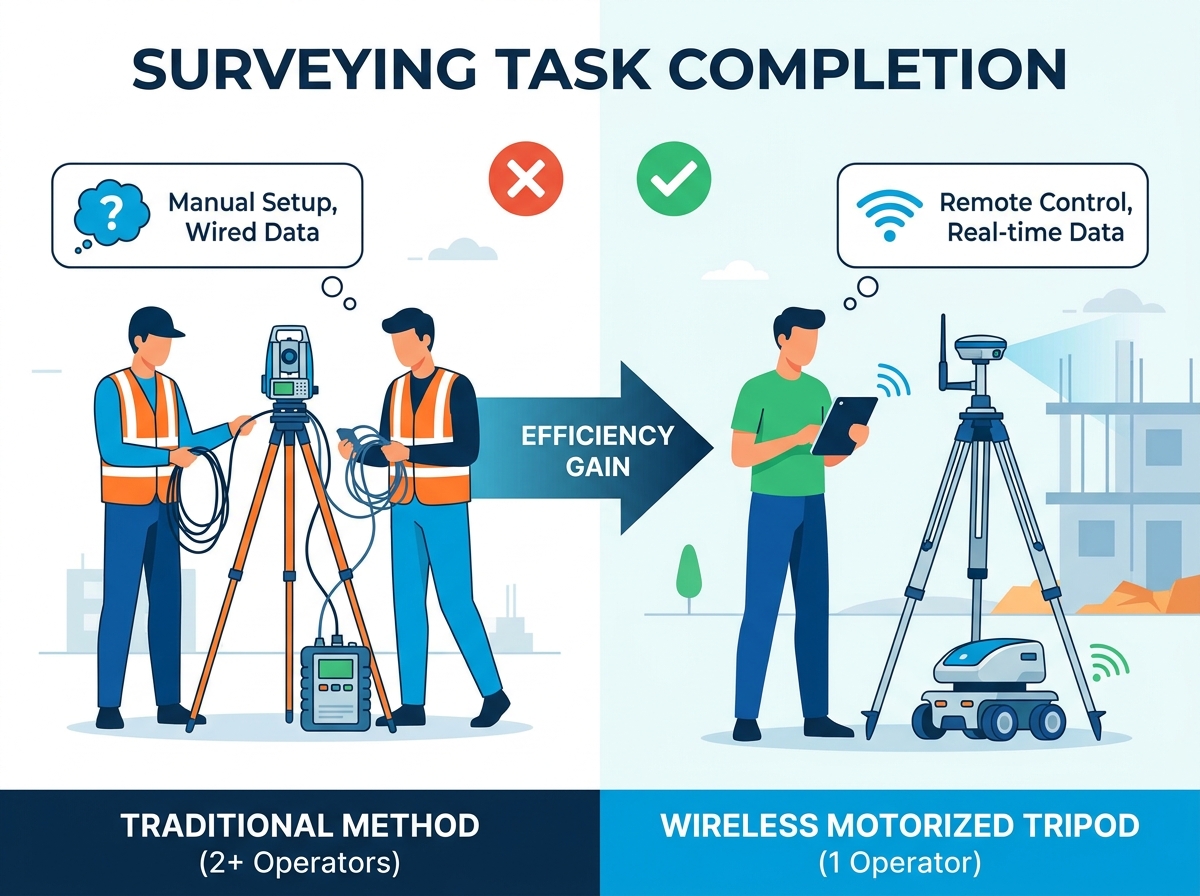
The surveying and construction industries face an ongoing skilled labor shortage, forcing many firms to transition from traditional two-person crews to single-operator workflows. While robotic instruments track prisms automatically, a major physical bottleneck remains. Solo operators suffer from constant back-and-forth travel between the prism pole and the instrument. They must manually level the setup, adjust heights, and correct the line of sight. This constant walking causes severe site-walk fatigue, draining physical energy and burning valuable daylight.
A wireless motorized tripod offers a compelling solution to this exact bottleneck. By automating the physical adjustments at the instrument base, this technology keeps the surveyor at the rod. This article provides an objective, technical evaluation of this equipment. We will explore whether a motorized setup can genuinely support a solo operator without compromising accuracy, stability, or field efficiency.
Feasibility: A wireless motorized tripod enables true single-operator workflows by allowing remote auto-leveling and height adjustments directly from the rover or data collector.
Efficiency Gains: Reduces instrument setup and repositioning time by eliminating the physical walk back to the total station or scanner.
Operational Limitations: Success depends heavily on payload capacity, battery management, the tripod’s stability in high-wind or high-vibration environments, and the physical weight penalty of carrying motorized gear.
ROI Timeline: While the initial capital expenditure is high, the elimination of a second crew member's labor cost typically yields a positive ROI within the first operational year, provided the equipment is utilized consistently.
A successful single-operator workflow requires uninterrupted data collection. The surveyor must control the entire site from the prism pole. Remote error correction is mandatory. The operator needs the ability to maintain survey-grade accuracy without physical instrument contact. Every trip back to the instrument introduces delays. True solo success means the surveyor only touches the tripod during the initial physical placement and the final teardown. You need a system that handles micro-adjustments on the fly. If the ground thaws and the setup settles, you must be able to re-level without walking 500 feet across a muddy site.
The standard instrument operator and rod person dynamic relies on constant verbal communication. The instrument operator handles leveling, sighting, and data entry. Current robotic total station setups eliminate the need for someone to look through the glass. The robotic station tracks the prism automatically. However, the solo operator still must manually level the tripod over the control point. If the setup settles in soft dirt, the operator must walk back to re-level the tribrach. This physical requirement breaks the efficiency of the robotic workflow. You end up spending more time walking than shooting points.
Comparison of Surveying Workflows | |||
Workflow Type | Leveling Method | Operator Movement | Efficiency Impact |
|---|---|---|---|
Traditional Two-Person | Manual at instrument | Stationary at instrument / Rover moves | High labor cost, fast point collection |
Standard Robotic (Solo) | Manual at instrument | Constant walking between rover and instrument | High fatigue, moderate point collection |
Motorized Robotic (Solo) | Remote via data collector | Stationary at rover | Low fatigue, high point collection |
Manual heavy-duty wood and fiberglass tripods provide excellent vibration dampening. They require entirely manual leg adjustments. Motorized tribrach adapters offer a middle ground. They sit between a standard tripod and the instrument, providing micro-leveling capabilities. Fully integrated wireless motorized tripods combine these concepts. They feature motorized actuators built directly into the legs or the central column. Adding motorization and wireless control closes the final physical gap in the solo workflow. The operator commands the hardware remotely, eliminating the walk back to the control point. This shift represents a fundamental change in how we approach site control.
Motorized actuators adjust the leg length and instrument height with millimeter precision. The operator places the tripod roughly over the point. From the data collector, they initiate the leveling sequence. Internal sensors detect the tilt. The motors drive the legs up or down to achieve a perfect level. This outcome delivers precise leveling over a control point without manual intervention. It saves minutes per setup. Over a long day with multiple traverses, these saved minutes compound into hours of reclaimed production time.
Roughly position the tripod over the control point.
Secure the spiked feet into the ground.
Mount the robotic total station.
Walk to the rod location.
Initiate the auto-leveling sequence via the data collector.
Verify the digital bubble on the controller screen.
The motorized tripod transmits real-time level vial data directly to the field controller. This telemetry allows the operator to verify leveling accuracy from the prism pole. You can check the digital bubble before taking critical shots. If a heavy truck drives by and vibrates the ground, the operator sees the disturbance immediately. They can trigger a remote re-leveling command. This constant verification ensures data integrity without requiring physical proximity to the instrument. You never have to guess if your setup is still tight.
Physical mounting relies on the industry-standard 5/8"-11 thread. This ensures the tripod accepts almost any modern surveying instrument. Digital compatibility requires specific communication protocols. The tripod interfaces with major robotic total stations and standard data collectors. Communication typically occurs via Bluetooth Class 1, Wi-Fi, or proprietary radio links. Operators must verify that their specific field software can read the telemetry from the tripod's control unit. Without software integration, you just have a heavy, expensive manual tripod.
Realistic communication range typically extends up to 100 meters under clear line-of-sight conditions. Latency in command execution must be minimal. When you press the level button, the motors should engage within milliseconds. Signal degradation occurs in high-interference environments. Urban corridors with dense Wi-Fi signals cause connection drops. Active industrial sites with heavy machinery generate electromagnetic interference. Operators must understand these limitations to maintain a reliable remote workflow. Always establish a clear line of sight for the radio link.
Motorized legs face mechanical limits on steep grades. Loose soil, deep mud, and rocky terrain challenge the auto-leveling algorithms. The tripod requires aggressive spiked feet to bite into the ground. Dual-clamping systems ensure the legs do not slip under heavy loads. Wide-stance capabilities are essential for maintaining a low center of gravity. Operators must still use basic surveying sense when choosing a setup location. The motors cannot compensate for a fundamentally unstable surface. If you set up on a swamp, the rig will sink, motors or no motors.
Motorized joints and internal gears handle micro-vibrations differently than solid wood. Traditional fixed wooden tripods absorb ambient vibrations naturally. Motorized systems rely on tight gear meshing to prevent wobble. High wind loads test the rigidity of the extended actuators. Wind vibration impacts angular accuracy. It triggers instrument compensator alerts. High-quality motorized tripods use heavy-duty worm gears that lock physically in place to resist wind deflection. You need to ensure the gear locks are fully engaged before walking away.
Operators must calculate the total payload accurately. You must add the weight of the instrument, the tribrach, and any external battery packs. Compare this total against the motorized tripod’s maximum rated capacity. This capacity typically ranges from 15 to 30 lbs. Exceeding this limit causes motor burnout. It leads to structural failure or system tipping. Proper balance ensures the motors work efficiently without drawing excessive battery power.
Typical Payload Calculation for Motorized Tripods | |
Component | Average Weight (lbs) |
|---|---|
Robotic Total Station | 10.5 - 12.0 |
Tribrach & Adapter | 1.5 - 2.0 |
External Battery Pack | 1.0 - 2.5 |
Total Payload | 13.0 - 16.5 |
Moving mechanical parts are vulnerable to the elements. Exposed actuators and electronic control units must withstand dust, mud, and heavy rain. Surveyors should seek equipment with IP65 or higher certifications. Active construction sites destroy fragile electronics. The motorized housings must feature heavy-duty seals. The physical buttons on the tripod base need weatherproof membranes to survive daily field abuse. If water gets into the motor housing, the entire unit fails.
Battery life dictates field success. Constant leveling adjustments draw significant power. Cold weather causes severe battery degradation. A standard battery might last ten hours in the summer but only five in the winter. Hot-swappable power sources are a necessity in the field. The operator must carry spare batteries to ensure the tripod does not die mid-traverse. Power management requires disciplined charging routines back at the office. You cannot afford to leave the batteries in the truck overnight during winter.
Solo operators face a harsh physical reality. They must carry all their gear across a site in one trip. This payload includes the robotic total station, the motorized tripod, the prism pole, the controller, safety gear, and spare batteries. Navigating a muddy construction site with this load demands physical endurance. The added bulk of automated equipment changes how a surveyor moves through the environment. You have to plan your access routes carefully to avoid exhausting yourself before the survey even begins.
A standard carbon fiber tripod weighs approximately 8 to 10 lbs. A wireless motorized tripod contains heavy internal components. It houses batteries, copper-wound motors, and ruggedized electronic housings. These systems typically weigh between 15 and 22 lbs. This significant weight increase directly impacts operator fatigue. The surveyor must balance the time saved by remote leveling against the physical toll of carrying the heavier equipment. Over a ten-hour shift, those extra ten pounds feel like fifty.
Minimizing operator fatigue requires smart carrying solutions. Backpack harnesses distribute the weight of the total station evenly. Padded shoulder straps for the tripod prevent bruising. Vehicle transit considerations are also critical. Custom truck bed sliders allow the operator to pull the heavy tripod out without straining their lower back. Proper ergonomics ensure the solo operator remains productive during long field days.
Use a dual-shoulder harness for the total station case.
Attach thick, aftermarket padding to the tripod carrying strap.
Utilize an all-terrain utility cart for flat, open sites.
Install a pull-out bed slide in the survey truck.
Calculating ROI requires a clear conceptual framework. You must compare the upfront cost of the motorized tripod against the fully burdened hourly rate of a secondary crew member. This burdened rate includes wages, taxes, insurance, and benefits. While the initial capital expenditure for motorized gear is substantial, the labor savings accumulate rapidly. Eliminating a second salary changes the financial dynamics of the survey department. You recover the equipment cost by reallocating that second person to another revenue-generating crew.
Saving 5 to 10 minutes per setup transforms the workday. If a surveyor performs six setups a day, they save up to an hour of idle time. This reclaimed time translates directly to total daily point collection volume. The operator shoots more topography. They stake out more points. This increased efficiency accelerates the overall project timeline, allowing the firm to bill for completed phases faster. More points per day means higher profitability per project.
Motorized tripods introduce hidden maintenance costs. They possess moving parts, gears, and electronic components. These elements require regular cleaning to remove abrasive grit. Firmware updates must be managed. Physical calibration checks ensure the internal tilt sensors remain accurate. If damaged, the tripod requires specialized repair services. You cannot simply fix a burned-out actuator with standard hand tools. You must factor in annual service center visits to keep the motors running smoothly.
Lone workers face unique safety risks. Operating solo in remote or hazardous terrains shifts liability to the firm. If the surveyor falls or suffers an injury, no one is there to help. Remote lone-worker check-in protocols are mandatory. The firm must implement GPS tracking and scheduled communication intervals. Safety considerations must evolve alongside the adoption of single-operator hardware. You need a reliable communication plan before sending one person into the woods with heavy gear.
Leaving an expensive instrument and motorized tripod unattended is highly vulnerable. The solo operator often traverses far from the setup location. Thieves target unattended surveying gear on active sites. Mitigation tactics are essential. Firms should install hidden GPS tracking beacons inside the equipment housings. Mechanical locks can secure the instrument to the tribrach. Proximity alarms alert the operator's data collector if the tripod moves unexpectedly. Maintaining strict line-of-sight operational rules prevents opportunistic theft. Never set up near a busy public road and walk away.
Assuming complete autonomy is a dangerous operational risk. Automation fails in unpredictable environments. Manual verification checks remain a strict necessity. Operators must perform daily field calibrations. They must monitor the setup for mechanical settling in soft ground over long sessions. If the tripod sinks slightly, the auto-leveling might compensate, but the instrument height will change. The surveyor must verify control points frequently to catch these automated errors. Trust the motors, but verify the data.
Transitioning to fully remote workflows involves a steep learning curve. Solo operators must learn new software interfaces. They need standardized operating procedures for remote troubleshooting. When the wireless link fails, the operator must know the pairing reset sequence. They must understand the manual override procedures to continue working without automation. Proper training prevents expensive downtime when the technology acts unpredictably in the field. You cannot figure out Bluetooth pairing while standing in the rain on a job site.
Audit your current average setup times to establish a baseline. Calculate your specific labor costs to determine your break-even point. Finally, contact your equipment provider to request a hands-on field demonstration using your existing robotic total stations and data collectors.
Track your daily setup and teardown times for one week.
Calculate the physical payload weight your solo operators currently carry.
Schedule a field demo with a motorized tripod on your most difficult terrain.
Review your field software to ensure full telemetry compatibility.
A: The typical payload capacity ranges from 15 to 30 lbs. It is crucial to factor in the combined weight of the robotic total station, the tribrach, and any auxiliary battery mounts. Exceeding this limit can cause motor burnout or compromise the stability of the setup.
A: Yes, but it requires robust physical locking mechanisms. Unlike traditional fixed legs, motorized joints must use high-quality worm gear actuators that lock securely in place. This prevents micro-movements and wind deflection, ensuring the instrument's compensator remains within its working range.
A: Battery life typically ranges from 8 to 12 hours under normal conditions. The exact duration depends heavily on the frequency of setups, how often the auto-leveling motors engage, and ambient temperatures. Cold weather significantly reduces battery performance.
A: Physical mounting is nearly universal due to the standard 5/8"-11 thread. However, wireless software integration, remote control functionality, and telemetry display depend entirely on the manufacturer's software and the specific data collector's compatibility.
A: The tripod uses internal tilt sensors and MEMS accelerometers to read its position. It then commands independent motorized leg actuators to adjust their length. This achieves a level plane mechanically before the instrument's internal compensator takes over for fine adjustments.
A: The system includes mechanical fail-safes. If the signal drops, the tripod mechanically locks its current position to maintain stability. The operator can manually override the system using physical control buttons located directly on the tripod base to continue working.
A: Motorized tripods typically weigh 5 to 10 lbs more than standard carbon fiber models. This added weight comes from the internal copper-wound motors, heavy-duty gears, onboard batteries, and the ruggedized electronic housings required for field use.