
 English
Views: 0 Author: Site Editor Publish Time: 2026-07-09 Origin: Site


Terrestrial laser scanning data capture speeds hit millions of points per second, but physical equipment setup and manual elevation adjustments remain the primary bottlenecks in field operations. Surveyors encounter heavy operational friction when deploying manual heavy-duty tripods in complex, high-hazard, or multi-level environments like MEP rooms, industrial plants, and active construction sites. Time lost to manual cranking, line-of-sight obstructions, and physical operator fatigue from handling heavy payloads at height severely limits daily productivity.
To overcome these physical limitations, upgrading field hardware is necessary. Integrating a specialized motorized tripod for 3D laser scanning shifts the bottleneck entirely. This equipment transforms manual height adjustments into an automated, single-operator process. By removing the physical strain of manual lifting, field teams directly increase daily scan volumes, protect expensive optical hardware from accidental drops, and ensure high-accuracy data acquisition across challenging topographies.
Setup Time Reduction: Motorized tripods eliminate physical cranking and manual leveling iterations, reducing per-station setup and adjustment times by up to 50%, which compounds into significantly higher daily scan counts.
Enhanced Equipment Safety: Automated, smooth elevation control and integrated anti-drop braking systems mitigate the risk of accidental drops or jarring movements when handling high-value 3D laser scanners.
Line-of-Sight & Shadow Reduction: Push-button and remote-controlled height adjustments allow operators to easily scan above obstacles (e.g., drop ceilings, structural beams, industrial piping) without dismantling, moving, and re-leveling the setup.
Remote Field Operations: RF remote control or Bluetooth app connectivity allows operators to trigger elevation changes from a safe distance, removing the user from the scan's line of sight and eliminating human-induced vibration during data capture.
ROI Justification: The initial capital expenditure is rapidly offset by reduced field hours, enabling single-operator workflows and faster project turnarounds in VDC, BIM, and structural engineering applications.
Manually elevating heavy scanners using traditional crank-up, pneumatic, or friction-lock tripods exacts a heavy physical toll on field operators. Devices like the Leica RTC360, Trimble X7, Faro Focus, and Z+F Imager carry substantial weight, especially when combined with heavy-duty tribrachs and external batteries. Forcing an operator to repeatedly crank a heavy payload upward causes severe fatigue over an eight-hour shift. This physical strain slows down the operator and increases the likelihood of handling errors during the mounting and dismounting phases.
Beyond physical fatigue, manual tripods introduce severe inefficiencies regarding leveling. Every time an operator adjusts the height using a manual locked-collar or crank system, the tripod base undergoes torsional torque. This movement shifts the center of gravity and frequently knocks the entire setup out of level. The operator must then spend valuable minutes re-leveling the bubble or digital inclinometer before initiating the next scan. When multiplied across fifty or sixty setups in a single day, these wasted minutes compound into hours of lost production.
Physical safety hazards present another major limitation. When capturing overhead utilities, high ceilings, or complex structural steel, operators often stand on ladders or scaffolding to manually adjust the scanner height. Elevating a heavy, expensive optical instrument while balancing on a ladder introduces severe fall risks and equipment drop hazards. This practice violates many strict site safety protocols and exposes surveying firms to unnecessary liability.
An efficient scanning workflow relies on maximizing the number of successful scans per hour while maintaining strict point cloud registration accuracy. Every minute spent wrestling with tripod legs or manually cranking a center column is a minute the scanner is not capturing data. Modern workflows demand equipment that minimizes operator fatigue and completely removes physical safety risks from the equation. The goal is to keep the scanner moving and capturing data continuously.
To justify hardware upgrades, field teams must establish clear baseline metrics. A standard manual setup, including leveling, elevating, and re-leveling, might take up to five minutes per station in complex environments. Upgrading to automated elevation systems should reduce this setup and adjustment time to under two minutes per station. Achieving this metric allows a single operator to increase their daily scan count by thirty to forty percent, fundamentally altering project timelines and profitability.
Workflow Metric | Manual Heavy-Duty Tripod | Motorized Tripod System |
|---|---|---|
Average Setup Time | 4 to 6 minutes per station | 1 to 2 minutes per station |
Leveling Retention | Requires re-leveling after height change | Maintains level during elevation |
Operator Fatigue | High (manual cranking of heavy payloads) | Low (push-button operation) |
Safety Risk at Height | High (requires ladders/scaffolding) | Low (remote operation from ground) |
Motorized columns allow for continuous, precise, and repeatable vertical height adjustments. Operators can easily elevate the scanner to capture data over obstructions like HVAC ductwork, temporary construction barriers, or complex piping networks without ever moving the tripod base. This capability is critical in dense industrial environments where finding a clear line of sight is notoriously difficult. By simply pushing a button, the scanner rises smoothly above the visual obstruction.
Capturing multiple precise elevations from a single station drastically improves overall point cloud quality. An operator can initiate a scan at floor level, raise the column to eye level for a second scan, and finally extend it to the ceiling plenum level for a third. This multi-elevation approach from a single fixed coordinate improves point cloud density, reduces data shadows behind complex geometry, and simplifies target-to-target registration in post-processing software.
RF remote controls and smartphone app integrations that drive the motorized column provide immense value in the field. Operators no longer need to stand directly next to the instrument while it elevates. They can trigger height adjustments and initiate scans from an adjacent room or behind a structural column. This remote capability ensures the operator never appears in the scan data, eliminating the need to clean out human artifacts during the drafting phase.
Remote elevation changes also allow operators to stay entirely clear of hazardous areas. When scanning active roadways, unstable structures, or high-voltage substations, the operator can position the tripod, retreat to a safe distance, and adjust the scanner height remotely. This safety separation is a mandatory requirement on many highly regulated industrial sites.
Furthermore, remote operation eliminates human-induced micro-vibrations. Because the operator does not touch the tripod to raise or lower it, the scanner remains perfectly stable. The motorized column glides into position, stops smoothly, and allows the scanner's internal compensator to settle immediately, ensuring maximum data accuracy.
Motorized lifting systems rely on robust mechanics, such as heavy-duty worm gears and linear actuators, to safely raise and lower payloads exceeding 15 to 20 kilograms. These mechanical systems are engineered specifically to handle the off-axis weight and rotational forces generated by modern terrestrial laser scanners. The motors provide consistent torque, ensuring the column does not stall or jerk when lifting heavy instruments.
Integrated safety mechanics protect the high-value hardware. Automatic locking gears ensure that the column cannot back-drive or collapse under weight. Slip clutches are built into the drivetrain to prevent motor burnout or scanner damage if the column accidentally hits an overhead obstruction like a ceiling beam or low-hanging pipe. Anti-drop safety brakes provide a final layer of physical security, locking the column in place instantly if a mechanical failure occurs.
Minimizing the manual handling of high-value scanning equipment at height directly reduces liability and insurance risks. When operators do not have to physically lift a heavy scanner above their heads while standing on uneven ground, the risk of a catastrophic drop drops to near zero. Insurance underwriters often view automated lifting systems as a proactive risk mitigation strategy.
BIM/MEP Coordination: Scanning above suspended ceilings and inside tight utility shafts becomes a streamlined process. Operators can elevate the scanner through ceiling grid tiles without building scaffolding or utilizing scissor lifts.
Storage Tank Strapping & Calibration (API 650/653): Elevating scanners through manways and internal structures safely allows for accurate volumetric calculations and deformation analysis without requiring confined space entry for the operator.
Infrastructure & Forensic Mapping: Overcoming roadside barriers, terrain elevation changes, or capturing overhead bridge clearances rapidly keeps field crews out of active traffic lanes and accelerates data collection.
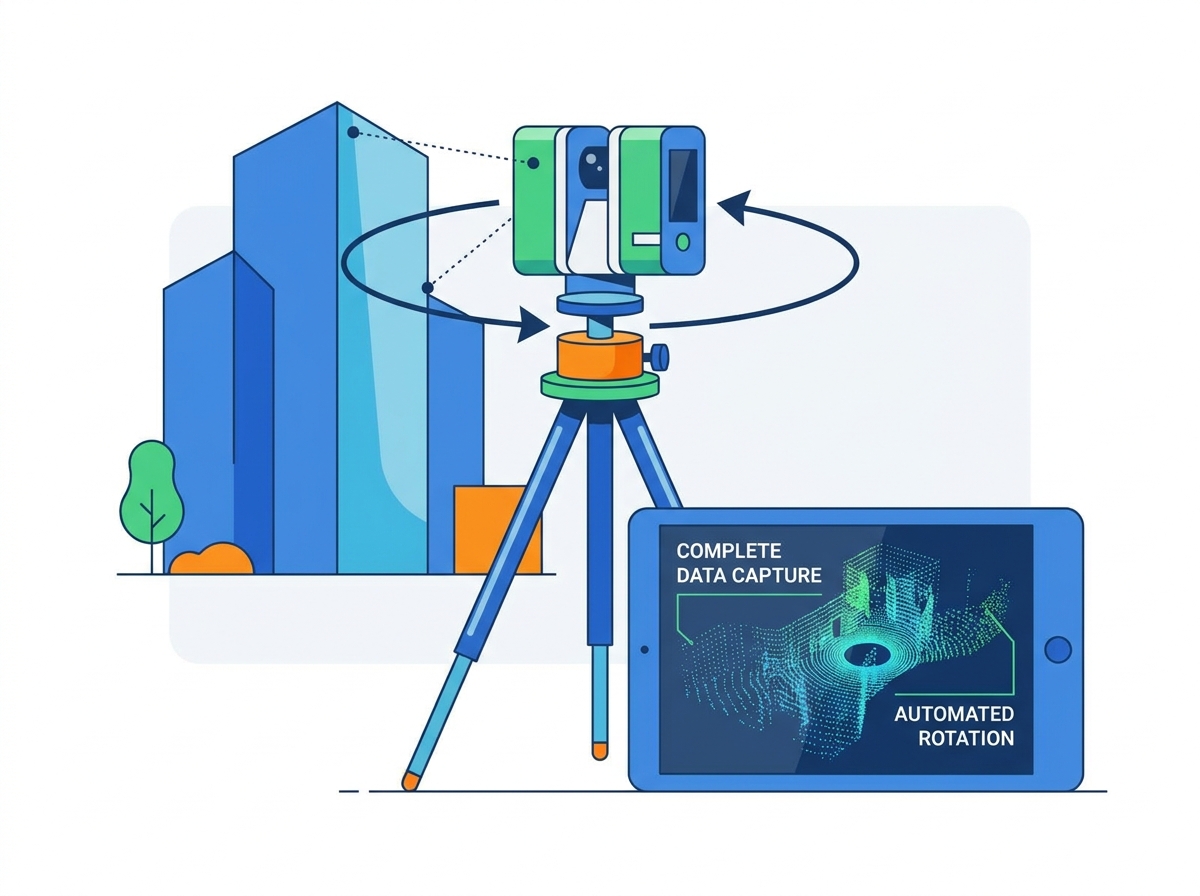
Matching tripod payload ratings with specific scanner weights is the first step in hardware evaluation. You must account for the total deployed weight, which includes the scanner body, internal batteries, heavy-duty quick-release adapters, and any external panoramic cameras or targeting prisms. Selecting a tripod with a payload capacity that barely meets your scanner's weight will result in motor strain and reduced battery life. Always choose a system with a payload rating at least twenty percent higher than your maximum deployed weight.
Mounting thread standards dictate how securely the scanner attaches to the motorized column. Most professional systems utilize a standard 5/8" x 11 threaded mount or proprietary quick-mount adaptors. The structural stability of the mounting plate is critical; it must be machined from solid aluminum or steel to prevent flexing. Any flex at the mounting point will amplify vibrations and degrade point cloud accuracy.
The structural integrity of the motorized column directly impacts micro-vibrations and wind-induced sway during the scanning process. Columns manufactured from thick-walled carbon fiber or hard-anodized aluminum offer the best stiffness-to-weight ratios. Carbon fiber provides excellent vibration dampening properties, allowing the scanner to settle faster after elevation changes, while aluminum offers superior resistance to blunt force impacts in harsh industrial settings.
Tripod torsional rigidity is directly related to the reduction of registration errors in post-processing software like Leica Cyclone, Faro Scene, or Trimble RealWorks. If the tripod twists slightly as the scanner rotates at high speeds, the resulting point cloud will exhibit rotational drift. A high-quality motorized tripod utilizes tight-tolerance guide rails and interlocking column segments to eliminate rotational play completely.
Stabilizing accessories further enhance data accuracy. Dual-clamp leg locks prevent leg slippage under heavy loads. Heavy-duty leg braces and stay wires secure the tripod base against high winds on open sites. Exchangeable feet are mandatory; operators need sharp metal spikes to anchor the tripod into soil or gravel, and vibration-dampening rubber pads to isolate the setup from floor vibrations on concrete slabs.
Powering the motorized column requires robust electrical systems. Field teams must evaluate the differences between internal rechargeable batteries and external 12V/24V power packs. Internal batteries offer a cleaner setup with no exposed cables to snag on debris, but they limit operational time. External power packs provide extended run-times and can often be swapped out quickly without disturbing the tripod setup.
Continuous operation run-time is a critical specification. Manufacturers typically rate battery life by the number of full extension and retraction cycles under maximum payload, rather than hours of operation. A reliable system should guarantee enough cycles to complete a full day of scanning on a single charge. Charging cycles and battery degradation over time must also be factored into the maintenance schedule.
To ensure uninterrupted full-day scanning operations in remote sites, hot-swappable batteries are highly recommended. If the battery dies mid-scan, the operator can replace the power source without losing the station setup. Additionally, manual backup hand-cranks are essential fail-safes. If the motor fails or the batteries completely drain, the operator must be able to lower the scanner safely using a manual override.
Field crews must balance a tripod’s collapsed transport length against its maximum operational height. Systems designed to reach overhead heights of three to five meters often feature long collapsed lengths that may not fit horizontally in standard SUV trunks or standard shipping cases. Telescoping multi-stage columns offer a better transport ratio but introduce more mechanical joints that must be secured against torsional flex.
The tripod’s foot spread, or overall footprint, determines its stability at maximum extension. A wider footprint is necessary to prevent tipping when a heavy scanner is elevated to four meters, particularly on uneven terrain or industrial grating. However, a massive footprint can restrict deployment in tight corridors or cluttered MEP rooms. Adjustable leg angles with secure locking detents allow operators to customize the footprint based on the specific site constraints.
Deploying a motorized tripod for 3D laser scanning fundamentally changes crew dynamics. Historically, high-elevation or complex multi-elevation tasks required a two-person crew: one surveyor to manage the heavy manual extensions and a second person to act as a safety spotter and assist with leveling. Automated elevation allows a single surveyor to perform these exact tasks safely and efficiently. Cutting the required field crew in half immediately reduces labor costs and allows surveying firms to deploy the second technician to a different revenue-generating project.
Calculating the break-even point for this hardware requires analyzing increased daily scan capacity against reduced billable field hours. If an operator utilizing a manual tripod averages 40 scans per day, upgrading to a motorized system can easily push that average to 65 scans per day by eliminating setup friction. This increased throughput means a project scheduled for three days can be completed in two. The operational savings from reduced hotel stays, per diems, and hourly wages quickly offset the initial capital expenditure.
Furthermore, the extended lifespan of the scanners themselves contributes heavily to the ROI. By eliminating the physical shock, jarring movements, and drop risks associated with manual handling at height, the internal optics and calibration of the scanner remain intact longer. Reducing the frequency of factory recalibrations and avoiding catastrophic repair bills adds significant long-term financial value.
Deploying motorized components in harsh environments exposes the hardware to dust, concrete slurry, rain, mud, and extreme temperatures. Unlike manual tripods that can be hosed off, motorized systems contain sensitive electronics, circuit boards, and exposed gearing. Field teams must understand the environmental limitations of their equipment before deploying it in heavy rain or highly abrasive industrial settings.
Ingress Protection (IP) ratings dictate the equipment's survivability. The motor, gear assembly, and battery housings must carry an IP54 rating or higher to withstand standard construction site conditions. An IP54 rating ensures the system is protected against dust ingress that could interfere with the gears, and splashing water from any direction. Operating below this rating in harsh conditions will inevitably lead to motor failure or electrical shorts.
Motorized tripods require strict preventative maintenance schedules to prevent binding or field failures. The telescoping columns, guide rails, and exposed worm gears must be kept clean and lubricated according to the manufacturer's specifications. Allowing concrete dust or grit to accumulate in the gear tracks will strip the gears and burn out the lifting motor.
Operators must be thoroughly trained on the protocol for manual overrides. If the motor or battery fails during a deployment, forcing the column down manually without disengaging the drive system will destroy the internal mechanics. Understanding how to properly engage the manual hand-crank ensures the scanner can be retrieved safely without damaging the tripod.
The logistical challenges of transporting heavier motorized tripods cannot be ignored. These systems are significantly heavier and bulkier than standard surveying tripods. Transporting them on commercial flights often incurs oversized baggage fees, and moving them across rugged terrain requires dedicated transport carts or multi-person carries.
To protect the sensitive motors and straightness of the column rails during transit, custom, IP67-rated protective hard transport cases are critical. Throwing a motorized tripod into the back of a pickup truck without a hard case will result in bent rails and misaligned gears, rendering the automated elevation system useless.
A motorized tripod for 3D laser scanning is an essential workflow multiplier for high-volume, complex terrestrial scanning projects. When safety, speed, and accuracy are paramount, eliminating the physical bottleneck of manual elevation adjustments transforms field operations. By automating height changes, field teams capture more data, protect their high-value optical instruments, and significantly reduce operator fatigue.
When selecting a system, evaluate the hardware based on your heaviest scanner payload and the required maximum height for your typical environments. High-rise MEP coordination will require different column extensions than flat topographical surveys. Prioritize remote-control capabilities for safety and ensure the IP rating matches your operating climates to prevent premature equipment failure.
Audit your current average setup time per scan to establish a baseline metric.
Calculate the potential labor savings of transitioning to a single-operator workflow.
Review recent projects to identify hours lost to manual adjustments and line-of-sight obstructions.
Contact us to request a field demonstration or technical spec sheet.
A: Standard motorized tripods typically offer maximum operational heights ranging between 3 to 5 meters. Advanced models utilize multi-stage telescoping columns to achieve these heights while maintaining a low center of gravity and wide foot spread to ensure structural stability at maximum extension.
A: Yes, professional-grade motorized tripods are engineered with payload capacities ranging from 15kg to over 30kg. This easily accommodates industry-standard heavy scanners, including the Leica RTC360, Trimble X-series, and Faro Focus, along with their associated heavy-duty tribrachs and external batteries.
A: Battery life is generally measured in operational cycles rather than hours. A standard fully charged battery typically provides enough power for 50 to 80 full extension and retraction cycles under maximum load, easily lasting a full 8-hour workday. Many systems also feature hot-swappable batteries for uninterrupted operation.
A: High-quality motorized tripods actually protect accuracy. They feature robust locking mechanisms, carbon fiber or anodized aluminum construction, and high torsional rigidity. These elements prevent rotational drift and micro-movements during scanning, thereby maintaining strict accuracy and reducing registration errors in post-processing.
A: Motorized tripods incorporate multiple fail-safes, including automatic locking worm gears that cannot back-drive, anti-drop brake systems, and physical safety pins. These mechanisms ensure the column locks securely in place and prevents the scanner from collapsing, even in the event of a complete power loss.
A: Most professional motorized tripods are built for field use, but they have specific environmental limits. The motor, exposed gears, and battery housings typically require an IP54 rating or higher to protect against fine dust and splashing water. They should not be submerged or left exposed in torrential downpours without adequate protection.