
 English
Views: 0 Author: Site Editor Publish Time: 2026-08-08 Origin: Site


Complex surveying environments frequently present line-of-sight obstructions, high-clearance infrastructure, and deep shafts. These obstacles require elevating sensors well beyond standard equipment limits. Extending the working height of a motorized surveying tripod solves this core problem but introduces new operational challenges. Elevating high-value payloads like laser scanners and robotic total stations increases critical risks. You face torsional vibration, wind sway, and potential equipment damage. These factors degrade data accuracy and increase liability on the job site. Safely extending your setup requires a strict framework. You must focus on precise hardware selection, stability mechanics, and robust electrical integrations. Risk mitigation is essential to maintain survey-grade tolerances at maximum elevation. This guide breaks down the physical limitations, hardware solutions, and field safety protocols necessary to elevate your instruments without compromising data integrity.
Payload vs. Motor Capacity: Extending height directly impacts the center of gravity; accessories must align with both the static and dynamic load limits of the tripod’s internal elevation motor.
Material Rigidity is Non-Negotiable: Carbon fiber extensions offer superior vibration dampening and stiffness-to-weight ratios compared to standard aluminum, which is critical for reducing point cloud noise.
Environmental Constraints: Working at extended heights amplifies wind load; deploying secondary stabilization (guy wires, outriggers) is mandatory in exposed environments.
Thread and Mount Compatibility: Safe extension requires precision-machined 5/8" x 11 standard connections to prevent micro-movements between the motorized column and the sensor base.
Power and Control Realities: Elevated systems draw higher amperage and require remote height management systems to avoid physical interaction with the tripod during active scans.
Adding vertical extensions above the motorized column drastically shifts the center of gravity. A higher center of gravity makes the entire setup top-heavy and prone to tipping. You must calculate the exact weight of your sensor, batteries, and the extension mast itself. This combined weight cannot exceed the manufacturer limits. Surveyors must differentiate between static and dynamic payload capacities. Static capacity refers to the maximum weight the tripod can hold while stationary. Dynamic capacity dictates what the motor can smoothly lift and lower. Exceeding dynamic limits causes motor stalling and uneven elevation. This uneven movement risks dropping the payload or damaging the internal drive mechanism. When working on uneven terrain, a shifted center of gravity becomes even more hazardous. You have to account for the angle of the ground and how it interacts with the extended mast. A slight incline at the base translates to a massive offset at the top of a three-meter extension. This offset puts unequal pressure on the tripod legs, increasing the likelihood of a catastrophic tip-over if not properly counterbalanced.
Extended masts act as giant levers. They amplify wind resistance and ground-level vibrations. A gentle breeze at ground level exerts significant lateral force three meters in the air. This lateral force creates sway. Micro-vibrations directly impact angular accuracy and point cloud registration. When a laser scanner sways even a few millimeters, the resulting angular drift introduces massive noise into the dataset. You lose the tight tolerances required for structural monitoring or precise topographical mapping. Dampening these vibrations is a primary concern when operating at extended heights. Heavy traffic, heavy machinery operating nearby, or even footsteps on a concrete slab can transmit vibrations up the extended column. The longer the mast, the lower its natural frequency, making it more susceptible to these low-frequency ground vibrations. You must isolate the tripod base as much as possible and utilize materials that absorb rather than transmit these kinetic forces.
Lifting top-heavy loads places immense mechanical stress on internal components. Most motorized tripods utilize rack-and-pinion, worm gear, or belt-drive systems. Pushing these systems to their dynamic load limits accelerates gear wear. Worm gears offer excellent self-locking capabilities but suffer from friction under heavy loads. Rack-and-pinion systems provide smooth vertical travel but can strip teeth if the payload shifts abruptly. You must inspect these mechanisms regularly when frequently deploying vertical extensions. The constant upward thrust required to elevate a heavy scanner on a long pole generates significant heat within the motor housing. Over time, this thermal stress degrades the lubricants protecting the gears. Metal-on-metal contact increases, leading to jerky movements during elevation. This lack of smooth travel can throw off the compensator in your total station, forcing you to re-level the instrument multiple times during a single setup.
Lifting vertical extensions under load increases power consumption. The elevation motor requires higher amperage to overcome the added weight and friction. This increased draw drains internal batteries much faster than standard operations. Voltage drops pose a severe risk during elevation. A sudden drop in voltage can cause motor stalls or communication failures between the controller and the tripod. Using external, high-capacity auxiliary power sources mitigates this risk and ensures smooth, uninterrupted vertical travel. Cold weather exacerbates this issue. Battery efficiency plummets in freezing temperatures, reducing the available amperage just when the motor needs it most to push through thickened gear lubricants. Field crews must carry insulated battery packs and monitor voltage readouts constantly when operating extended masts in winter conditions to prevent mid-lift stalls.
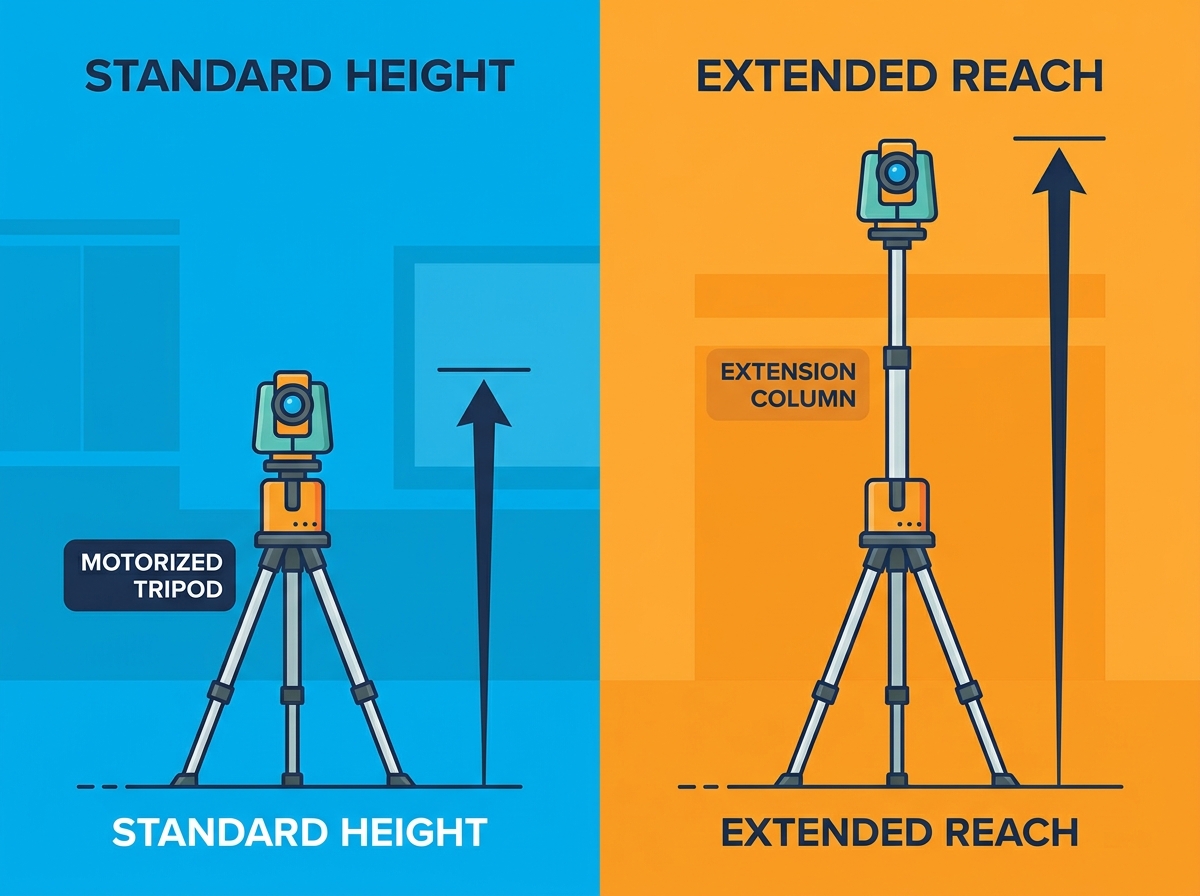
Surveyors typically choose between modular screw-on extensions and integrated telescopic masts. Modular extensions thread together to reach the desired height. They offer flexibility but introduce multiple connection points where micro-movements can occur. Integrated telescopic masts provide a single, continuous structure, reducing connection vulnerabilities. Locking mechanisms dictate the reliability of telescopic masts under heavy payloads. Collet locks provide 360-degree clamping force, resisting slippage effectively. Pin locks offer positive engagement at fixed intervals, guaranteeing the mast will not collapse. Pin locks are generally superior for heavy laser scanners. When selecting a mast, pay close attention to the wall thickness of the tubing. Thin-walled aluminum might save weight, but it flexes unacceptably under the lateral load of a heavy sensor. Thick-walled carbon fiber provides the necessary rigidity without adding excessive dead weight to the motor's dynamic load.
A standard tripod base cannot safely support an extended motorized column. You need wide-stance, heavy-duty tripod legs to counter the elevated center of gravity. The footprint must expand proportionally to the height extension. Dual-strut leg designs offer maximum torsional resistance. They prevent the tripod head from twisting during instrument rotation. Heavy-duty leveling feet with aggressive ground spikes ensure the base remains anchored in loose soil or gravel. Solid footing is the foundation of elevated stability. In environments where ground spikes cannot be used, such as finished concrete floors or sensitive indoor facilities, you must use spreader spreaders or floor guides. These accessories lock the tripod legs at a fixed angle, preventing them from splaying outward under the immense downward pressure of the extended mast and heavy payload.
Operating at extended heights requires secondary stabilization. You cannot rely solely on the tripod legs. Guy-wire kits anchored to the tripod head or extension collar provide critical lateral support. They counteract wind sway and dampen vibrations. Proper deployment of these systems is a learned field skill that directly impacts data quality.
Identify three solid anchor points on the ground, spaced evenly in a 360-degree radius around the setup.
Attach the guy wires to the designated collar on the extension mast, ensuring the collar is locked tightly.
Drive heavy-duty steel stakes into the ground at the anchor points, angling them away from the tripod.
Connect the wires to the stakes using adjustable turnbuckles.
Tighten the turnbuckles evenly, checking the mast with a torpedo level to ensure it remains perfectly plumb.
Apply weighted sandbags over the stakes if working in loose, sandy soil to prevent pull-out.
Engage the internal column clamping collars to relieve gear-train strain once you reach the target height.
Material choice dictates the performance of your extension mast. Carbon fiber provides high tensile strength and exceptional vibration-dampening properties. Aluminum offers rugged durability at a lower cost. For precision surveying, material rigidity is paramount. Carbon fiber significantly reduces motor strain due to its high stiffness-to-weight ratio. It absorbs micro-vibrations better than aluminum, directly reducing data noise in point clouds. The higher initial capital expenditure for carbon fiber is easily justified by the improvement in data quality and operational safety.
Feature | Carbon Fiber Extensions | Aluminum Extensions |
|---|---|---|
Weight Profile | Lightweight (reduces motor strain) | Heavier (increases dynamic load) |
Vibration Dampening | Excellent (absorbs micro-movements) | Poor (transmits ground vibrations) |
Structural Rigidity | High stiffness-to-weight ratio | Prone to flex under heavy lateral loads |
Thermal Expansion | Minimal expansion in extreme heat | Expands and contracts, affecting calibration |
Corrosion Resistance | Impervious to rust and oxidation | Requires protective coatings to prevent pitting |
Safe extension demands precision-machined 5/8" x 11 threaded adapters. Standard surveyor poles often feature loose thread tolerances. These loose connections allow the sensor base to shift during rotation, destroying angular accuracy. Mounting heavy scanners on extended poles increases the risk of thread stripping or cross-threading. Always inspect threads for wear before assembly. Use thread-locking compounds on semi-permanent extensions to eliminate micro-movements between the motorized column and the payload. A single damaged thread can compromise the entire setup. When threading heavy instruments onto a tall mast, the leverage makes it difficult to feel if the threads are engaging correctly. Field crews must be trained to back-thread until they feel the click of alignment before tightening down. Utilizing quick-release adapters with secondary locking collars can bypass the risks of repetitive threading while maintaining a rigid connection.
You must evaluate whether to purchase a tripod with a longer native stroke or add static poles to a shorter base. A native 3-meter internal lift provides superior stability. The manufacturer engineers the entire system to support the payload at maximum extension. Adding static poles to a shorter motorized base is more modular but introduces weak points. Native stroke systems enclose the lifting mechanism, protecting it from dust and moisture. Add-on extensions expose the payload to higher wind loads without the benefit of an engineered, unified mast structure. Native stroke systems also offer better integration with height-tracking software. The internal encoders read the exact extension distance, feeding that data directly into your field controller. With add-on poles, you must manually calculate and input the offset, introducing the potential for human error in the instrument height metadata.
Elevating a payload means you can no longer interact with the instrument physically. Remote control interfaces are mandatory. Cable remotes offer reliable, interference-free operation. Bluetooth apps and data collector integrations provide wireless convenience but require strong signal integrity. Digital height readouts and internal encoders are invaluable. They allow you to verify exact vertical displacement without manual tape measurements. This precise height feedback ensures accurate instrument setup and eliminates gross errors in your control network. When working in environments with heavy RF interference, such as active power substations or dense urban cores, wireless connections frequently drop. In these scenarios, a hardwired remote control is the only reliable way to manage the elevation motor. Ensure your equipment supports both wireless and wired control protocols to adapt to varying site conditions.
Transporting 3-meter extension masts and heavy-duty tripods presents logistical challenges. These systems do not fit in standard vehicle trunks. You often require dedicated transport cases and modified utility vehicles to move them to remote or confined job sites. Navigating tight indoor environments with long extension poles is equally difficult. You must balance the need for maximum height against the physical constraints of the site access routes. Modular systems offer better portability but sacrifice some rigidity. Moving this equipment across rough terrain requires specialized carrying harnesses. A single surveyor cannot safely carry a heavy-duty motorized base, a scanner, and multiple carbon fiber extensions simultaneously. You must factor in the additional manpower required to transport and assemble these systems when bidding on projects that require extended elevation setups.
Deploying an extended system takes significantly longer than a standard setup. You must calculate the time required to deploy guy wires, level the extended system, and perform comprehensive safety checks. Rushing this process leads to unstable setups and compromised data. The physical footprint of the setup also increases, requiring more space clearing and coordination with other trades on active construction sites.
Allocate at least 15 extra minutes for deploying secondary stabilization.
Perform dual-axis leveling checks before and after elevation.
Verify all locking collars and thread connections are secure.
Test remote control communication before lifting the payload.
Clear a safe drop zone radius around the tripod in case of structural failure.
Extending motorized columns exposes inner components to harsh elements. Dust, moisture, and abrasive grit on construction sites easily infiltrate exposed gear tracks and telescoping sections. This contamination accelerates wear and causes motor stalling. Strict maintenance protocols are required. You must clean wipers and seals daily. Apply specialized dry lubricants to exposed gears to prevent grit accumulation. Verify the IP rating of the motorized base to ensure it can withstand the specific environmental conditions of your site. Working in coastal environments introduces salt spray, which rapidly corrodes exposed aluminum and degrades electrical contacts. In these conditions, you must wipe down the entire extension mast and motorized column with fresh water and apply anti-corrosion sprays to all metal fittings at the end of every shift.
Extending a tripod is not always the optimal solution. You must weigh the operational efficiency of tripod extensions against alternative methodologies. Drone-based LiDAR or photogrammetry can capture high-angle data without the physical risks of elevating heavy terrestrial scanners. However, drones struggle in GPS-denied environments or tight indoor spaces. Extended tripods provide a stable, reliable platform for high-accuracy terrestrial scanning where drones cannot fly. Evaluate the specific accuracy requirements and site constraints before choosing a methodology. For example, scanning the underside of a bridge deck over an active highway prohibits drone flights due to airspace regulations and safety concerns. In this scenario, a motorized tripod with a rigid extension mast deployed from the ground is the only viable method to capture the required structural data safely and accurately.
A falling laser scanner is a catastrophic failure. Mandatory tethering and fall-arrest protocols are non-negotiable when mounting instruments on extensions. Use high-tensile steel cables to tether the sensor handle directly to a secure anchor point on the tripod base. Ensure the tether has enough slack to allow full vertical travel but is short enough to arrest a fall before the instrument strikes the ground. Inspect the tethering hardware daily for fraying or mechanical fatigue. Do not use nylon ropes or bungee cords for tethering. These materials stretch under load and will not stop a heavy instrument from impacting the tripod legs or the ground. Use certified wire rope lanyards with locking carabiners to ensure the payload remains attached to the mast even if the primary threaded connection fails completely.
Unexpected power loss or motor failure when a payload is fully elevated demands strict safety workflows. You must know how to safely lower the instrument without power. Systems with self-locking gearboxes prevent sudden, uncontrolled descents. Familiarize yourself with the mechanical manual release mechanisms. Some tripods feature a manual override crank or a release brake. Practice engaging these mechanisms in a controlled environment so you can react swiftly during a field emergency. If the manual override fails, do not attempt to climb the tripod or pull the mast down by force. Secure the area, attach additional guy wires to stabilize the stuck mast, and bring in a mechanical lift or scaffolding to safely retrieve the instrument from the top of the column.
Wind is the greatest enemy of elevated payloads. Establish hard limits for wind speeds. Halt operations immediately at sustained winds over 15 mph. Use a handheld anemometer at the site to monitor conditions constantly. Do not rely on local weather forecasts; microclimates around buildings or in canyons produce unpredictable gusts. If the extension mast shows visible sway, lower the payload immediately. Data collected during high wind events will be unusable due to excessive vibration noise. Temperature fluctuations also impact safety. Rapid cooling in the late afternoon can cause metal components to contract, loosening threaded connections and clamping collars. Field crews must re-check all tension points and locks if the ambient temperature drops significantly during a long scanning session.
The act of elevating a heavy payload can shift the tripod base slightly. Once the motorized column reaches full extension, you must verify the instrument's compensator limits. Check the dual-axis leveling on your data collector. If the instrument has drifted out of level, do not attempt to adjust the tripod feet while the payload is elevated. Lower the mast, re-level the base, and elevate again. Adjusting a fully extended, top-heavy tripod is extremely dangerous and risks tipping the entire system. Make it a standard operating procedure to record the compensator values immediately after reaching target height and again before lowering the mast. This data provides a quality control check, proving that the instrument remained stable and level throughout the duration of the scan.
To ensure safe and accurate data collection when extending your equipment, follow these immediate next steps:
Audit your current tripod motor specifications to confirm dynamic payload capacities before adding any extension hardware.
Upgrade to carbon fiber extension masts to minimize torsional vibration and reduce strain on the elevation motor.
Implement mandatory tethering protocols for all high-value sensors mounted above standard operating heights.
Establish strict environmental thresholds, halting all elevated scanning operations when sustained winds exceed 15 mph.
Train field crews on emergency manual descent procedures to safely recover payloads during unexpected power failures.
A: Maximum safe height is dictated by the manufacturer's base footprint, motor torque, and secondary stabilization. With proper guy wires and a wide-stance base, safe working heights typically range from 3 to 5 meters total. Always consult the specific load charts for your equipment.
A: Yes. Increased height amplifies wind sway and ground vibration. These micro-movements introduce noise into point clouds and cause angular drift. Using rigid carbon fiber masts and secondary stabilization minimizes this impact and preserves accuracy.
A: Standard rover poles are generally insufficient. They possess lower load ratings and lack the torsional rigidity required to support heavy scanners. Dedicated heavy-duty masts with precision threads are necessary to prevent dangerous flexing and thread failure.
A: Use carbon fiber extension materials, which naturally dampen vibrations. Deploy guy wires anchored to the ground, keep the tripod base as wide and low as possible, and shield the setup from direct wind using natural barriers or vehicles.
A: It depends on the manufacturer's guidelines. Exceeding the maximum static or dynamic payload limits will likely void the warranty, as excessive motor torque can cause gear failure. Always verify load capacities before adding aftermarket extensions.
A: Lifting heavier loads to greater heights increases the current draw on internal batteries. This higher amperage demand significantly reduces operational runtime. Using external auxiliary power sources is highly recommended for extended elevation tasks.
A: High-quality tripods use self-locking worm gears to prevent sudden descents during power loss. To lower the payload, safely access the auxiliary manual override crank or engage the manual release brake according to the manufacturer's emergency workflow.