
 English
Views: 0 Author: Site Editor Publish Time: 2026-07-06 Origin: Site


Modern surveying relies heavily on high-precision 3D laser scanners and robotic total stations. These advanced instruments demand absolute stability on active job sites. Setup time, physical strain, and millimeter-level accuracy directly dictate daily project profitability. Repetitive height adjustments introduce massive operational friction. Surveyors face physical fatigue, time loss, column drift, and micro-vibration risks when manually cranking heavy payloads to maximum elevation.
Evaluating traditional manual elevator tripods against emerging motorized solutions requires a practical framework. Field requirements, safety profiles, and operational efficiency determine which system aligns with your specific projects. This guide compares manual and motorized systems to help you optimize your surveying workflows and protect your hardware investments.
Workflow Velocity: Motorized tripods significantly reduce per-station setup and adjustment times, yielding the highest productivity gains for high-volume, multi-setup projects (e.g., indoor mobile mapping, BIM verification, and tunneling).
Payload, Precision, and Stability: Manual tripods offer reliable, battery-free lifting for remote environments but introduce physical vibration risks and manual locking errors. Motorized systems eliminate operator contact during height adjustments, preserving instrument calibration.
Safety and Ergonomics: The integration of a wireless motorized elevation tripod minimizes repetitive strain injuries (RSI) and shoulder strain associated with hoisting heavy equipment above shoulder level.
Elevation tripods serve as the critical foundation for spatial data collection. Baseline requirements include torsional rigidity, wind-load resistance, thermal expansion stability, payload capacity, and environmental resilience. A tripod must hold its position flawlessly. Any movement compromises the entire dataset. Surveyors depend on these structures to maintain absolute level across varying terrain, from loose gravel on highway projects to slick concrete in commercial high-rises.
The transition from lightweight optical levels to heavy, sensitive 3D laser scanners changed equipment demands entirely. The elevator column is now a critical point of potential physical failure. Mechanical wear or vibration-induced data noise directly impacts scan quality. Heavy scanners place immense downward force on the tripod chassis. This weight exacerbates any structural weaknesses in the column or locking mechanisms.
Choosing between manual and motorized systems is a strategic decision. It impacts data accuracy, crew fatigue, instrument longevity, and daily scan volume. Ergonomic preference is only one factor. The right tripod protects your primary instrument investment. It also ensures field crews maintain a consistent pace throughout long shifts without compromising setup quality.
Consider the daily routine of a field crew mapping a multi-story commercial building. They might perform fifty to eighty setups in a single shift. Every setup requires leveling the tripod, mounting the scanner, raising the column to clear obstacles, and locking it down. If the tripod column drifts even a fraction of a millimeter during the scan, the resulting point cloud will contain errors. These errors compound during the registration process in the office. You end up spending hours fixing data that should have been perfect from the start.
We see this constantly on active construction sites. Heavy machinery causes ground vibrations. Wind loads push against the scanner body. The tripod must absorb and mitigate these forces. A weak center column acts like a tuning fork, amplifying vibrations right into the scanner's compensator. This is why the mechanical design of the elevation mechanism matters so much.
Heavy-duty manual tripods rely on standard rack-and-pinion, worm-gear, or gear-driven crank mechanisms. These mechanical architectures provide straightforward lifting power. The operator turns a hand crank, which engages a gear track along the center column. This physical action translates rotational force into vertical lift. Friction clamps or locking collars then secure the column at the desired height.
Manual tripods offer distinct operational advantages. They require zero reliance on power sources. This guarantees unlimited field uptime in remote, multi-day wilderness surveys. They tolerate extreme temperatures without battery or electronic degradation. The familiar mechanical design ensures simple field-serviceability. Crews can often clean or grease the gears directly on site if necessary.
However, manual systems have notable operational limitations and failure modes. Operators endure physical strain when repeatedly lifting heavy scanners to heights exceeding three meters. Mechanical backlash, rack stripping, or column slippage can occur over time under heavy loads. Locking and unlocking manual friction clamps risks introducing column shifts or micro-vibrations. Slower adjustment speeds compound cumulative time loss across dozens of daily setups.
Let us break down the mechanical realities of manual cranking. When you turn that handle, you apply lateral force to the tripod. Even if you try to be gentle, you are pushing and pulling against the legs. On soft ground, this can push the tripod points deeper into the soil, throwing off your level. You then have to re-level the instrument before scanning. This adds minutes to every setup.
Furthermore, the gear tracks on manual tripods are exposed. If you work in dusty environments, sand and grit stick to the grease on the gears. This creates a grinding paste that wears down the metal over time. Eventually, the gears start to slip. You might raise the scanner, lock the clamp, and watch the column slowly slide down a few millimeters under the weight of the instrument. This drift ruins scan registration.
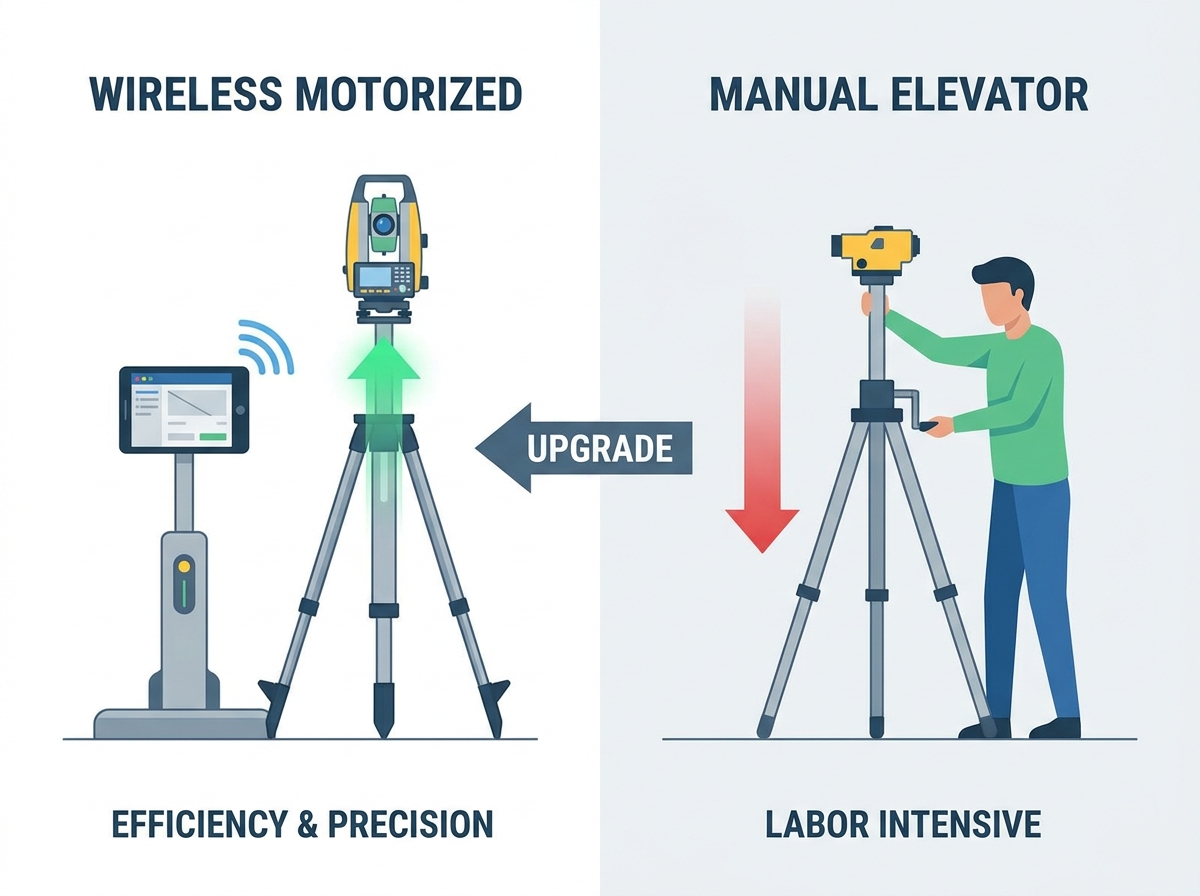
Motorized systems replace hand cranks with internal linear actuators. These utilize either ball screw or trapezoidal lead screw mechanics. The architecture includes battery housings, electric motor shielding, and RF or Bluetooth remote control modules. This design completely alters how surveyors interact with their equipment. You manage elevation through a digital interface rather than physical force.
The operational advantages directly improve field efficiency. True hands-free adjustment allows the surveyor to change height while monitoring the scanner's live feed. You ensure optimal line-of-sight without physically touching the column. Smooth, continuous vertical acceleration eliminates manual jarring. This protects the delicate internal mirrors and compensators of expensive scanners. Advanced height tracking integrates digital encoders for precise, repeatable height steps. This system also mitigates ergonomic risks by eliminating overhead cranking.
Integrating a wireless motorized elevation tripod does introduce specific limitations. You have a strict dependency on battery life and charging logistics. Battery chemistry performance drops in cold weather. Exposed electronic components, remote controls, and actuator seals face vulnerability to extreme moisture, dust, or physical impact. Field crews must manage power reserves carefully to avoid downtime.
The hands-free aspect changes the entire workflow. Imagine setting up over a control point. You level the tripod, mount the scanner, and step back. You pull out your tablet to connect to the scanner. You notice a steel beam blocking part of your scan window. Instead of walking back to the tripod, unlocking the column, cranking it up, locking it, and checking your level again, you simply press a button on your remote. The scanner rises smoothly. You watch the live feed on your tablet until the beam is out of the way. You start the scan immediately.
This workflow eliminates the physical interaction that causes level shifts. The linear actuator provides a perfectly vertical lift. There is no lateral force applied to the tripod legs. The instrument stays perfectly level throughout the elevation change. This is a massive advantage for high-accuracy work.
Locking mechanisms dictate stability. Manual friction clamps rely on user applied force. Motorized lead screw actuators provide static self-locking force. They naturally resist back-driving under heavy gravity loads. This mechanical advantage ensures the column remains perfectly stationary once the motor stops. You do not need to apply secondary physical locks that might bump the instrument.
Torsional rigidity affects footprint stability. Manual cranking can disturb the tripod's footing on loose soil or asphalt. The physical effort required to turn the crank transfers lateral force down the legs. Hands-free adjustment prevents this disturbance. High-speed laser scanner rotations demand strict yaw and pitch torque resistance. Both tripod types must pass standard rotation tests, but motorized units eliminate the human-induced variables during setup.
We can compare the stability characteristics directly:
Feature | Manual Elevator Tripod | Motorized Elevation Tripod |
|---|---|---|
Locking Mechanism | Friction clamp or locking collar (prone to slipping) | Self-locking lead screw (static hold) |
Vibration Introduction | High during cranking and locking | Zero during hands-free adjustment |
Level Disturbance | Frequent due to lateral cranking force | Rare due to vertical linear actuation |
Drop Risk | High if clamp fails or gear strips | Low due to mechanical screw design |
Lifting limits vary significantly between systems. Manual tripod lifting capacity is bottlenecked by human physical strength and crank gear ratios. Lifting a 20kg scanner requires substantial effort. Motorized tripods utilize high-torque DC motors. They lift heavy payloads effortlessly. This power transforms how crews handle bulky equipment.
Continuous duty cycles matter for high-intensity projects. Actuators have thermal limits. Repeatedly lifting heavy payloads during multi-floor scanning projects generates heat. Premium motorized units manage this thermal load effectively. Manual units do not overheat, but the operator will fatigue. Evaluating the expected daily lift volume helps determine which system will maintain consistent performance.
When you mount a heavy robotic total station or a high-end laser scanner, you are dealing with significant top-heavy weight. A manual crank requires you to fight gravity. If your hand slips off the crank handle, the column can slam down, potentially destroying a very expensive instrument. Motorized systems control the descent just as smoothly as the ascent. The motor acts as a brake, ensuring the payload never drops uncontrollably.
Workflow modeling quantifies the time difference per setup. Consider a scenario requiring fifty scans per day. Manual crank adjustments and physical level checks consume minutes at each station. A motorized unit controlled directly from the scanner's tablet saves crucial time. These saved minutes compound rapidly over a long shift.
Precise vertical movement simplifies target-free cloud-to-cloud registration. Software algorithms align point clouds better when the scanner moves vertically without lateral or rotational displacement. Manual cranking often introduces slight shifts. Motorized lifting keeps the vertical axis true. This accuracy reduces processing time in the office.
Let us look at a standard workflow comparison for a single setup:
Manual Workflow: Level tripod, mount scanner, unlock column, crank to height, lock column, re-check level bubble, adjust legs if necessary, start scan. (Average time: 3-4 minutes)
Motorized Workflow: Level tripod, mount scanner, step back, use remote to raise column to desired height, start scan. (Average time: 1-2 minutes)
Saving two minutes per setup might not sound like much. But multiply that by fifty setups a day. You save over an hour and a half of field time. That translates directly to more scans per day and faster project completion.
Ingress Protection (IP) dictates maintenance schedules. Exposed, greased manual gears attract dust, sand, and concrete slurry. They require frequent cleaning. Motorized units feature sealed electronic housings. These typically carry IP54 to IP65 ratings. They resist environmental contamination much better than open gear tracks.
Thermal expansion affects vertical drift. Carbon fiber columns resist temperature swings better than aluminum. This stability is vital during long, outdoor monitoring sessions. Sub-zero temperatures reduce lithium-ion battery efficiency in motorized units. Conversely, extreme cold stiffens lubricants in manual units, making them harder to crank. Both systems require specific winterization strategies.
If you work in heavy civil construction, your equipment gets covered in dust and mud. A manual tripod requires you to wipe down the gear track constantly. If you do not, the gears will bind. A motorized tripod encloses the lifting mechanism inside the column. The seals keep the dirt out. You just wipe down the outside of the column at the end of the day. This reduces daily maintenance requirements and extends the lifespan of the lifting mechanism.
Power management protocols prevent field downtime. Establish strict guidelines for your crews. Standardize battery platforms with existing GPS or GNSS gear where possible. Utilize dual-bay vehicle chargers. Carry high-capacity external power banks. Proper power logistics ensure the motorized tripod operates throughout the entire shift without interruption.
Field adoption requires standard operating procedures. Crews may resist new technology. Physical damage during transit is a real risk. Implement specialized transport cases. Use quick-release mounting plates. Train crews on proper cleaning and handling. Clear SOPs protect the equipment and ensure consistent usage across different teams.
Electronic failure in remote areas poses a significant risk. An actuator failure or dead battery miles from a vehicle halts production. Mitigate this by selecting motorized models featuring manual override drives. Backup manual cranks provide a crucial fail-safe. If the power fails, the crew can still complete the survey using traditional methods.
Training is critical when introducing motorized tripods. Surveyors are used to manhandling their gear. You have to train them to let the motor do the work. They need to understand the battery charging cycles. They need to know how to engage the manual override if necessary. Proper training ensures the equipment is used correctly and prevents accidental damage.
Choosing between a manual and motorized elevation tripod depends on field conditions, daily setup volume, payload weight, accuracy requirements, and available power support.
Manual elevator tripods remain practical for remote projects, low-frequency height adjustments, and environments where battery reliability or electronic durability may be a concern. Motorized systems are better suited to intensive scanning workflows that require frequent repositioning, heavy payload handling, and minimal disturbance to instrument level and calibration. Their hands-free vertical movement can reduce operator fatigue, setup time, vibration, and registration errors.
The decision should therefore consider total workflow efficiency rather than equipment price alone. Payload capacity, structural rigidity, environmental protection, battery management, manual override capability, and maintenance requirements should all be evaluated before selection. The best system is the one that maintains stable measurements while supporting safe, repeatable, and productive field operations.
A: Standard payload ranges typically fall between 10kg and 25kg. The exact capacity depends on the internal linear actuator specifications and the motor's torque rating. Always verify the manufacturer's maximum load limit before mounting heavy 3D laser scanners.
A: Most professional motorized tripods include fail-safes. They often feature a manual override drive or a backup hand crank. This allows surveyors to lower the instrument safely and continue working manually until a replacement battery is installed.
A: They are generally weather-resistant rather than fully waterproof. Most units carry an IP54 to IP65 rating. This means they are protected against dust ingress and low-pressure water jets from any direction, making them suitable for rain but not submersion.
A: No. Professional surveying tripods utilize shielded electric motors and isolated electronic housings. They are designed specifically to operate beneath highly sensitive equipment without introducing electromagnetic interference that could disrupt sensor data.
A: Sub-zero temperatures can significantly reduce lithium-ion battery efficiency, sometimes dropping capacity by up to 50%. Surveyors mitigate this by keeping spare batteries in warm pockets or vehicle cabs until immediately needed for operation.
A: It depends on the pairing protocol. Standard remotes pair one-to-one via Bluetooth or RF. However, advanced systems designed for complex monitoring setups can network multiple tripods to a single controller or tablet interface.
A: Premium motorized models feature integrated digital encoders that provide exact height readouts on the controller screen. For standard models, surveyors use manual measuring tapes from the ground to the designated instrument measuring mark.