
 English
Views: 0 Author: Site Editor Publish Time: 2026-07-02 Origin: Site


Elevating high-value, sensitive equipment—such as 3D laser scanners, total stations, or metrology sensors—introduces significant risk to both the hardware and the accuracy of the data collected. Manual crank tripods and friction-lock systems are prone to operator fatigue, uneven lifting, and sudden drops. When dealing with payloads exceeding 15-20 lbs and requiring millimeter-level stability, manual elevation becomes a bottleneck that compromises field efficiency and equipment safety.
A motorized elevation tripod replaces manual effort with precision electromechanical lifting. Understanding the internal mechanics, structural trade-offs, and exact evaluation criteria is critical before investing in this specialized reality-capture infrastructure.
Precision and Safety: Motorized elevation tripods utilize linear actuators and worm-gear drives to provide smooth, millimeter-precise vertical adjustments, eliminating the risk of sudden payload drops.
Primary ROI: The primary return on investment comes from reduced setup time, decreased operator fatigue, and the protection of high-value reality capture assets (often valued at $50k–$100k+).
Critical Specs: Purchasing decisions must be dictated by dynamic payload capacity (not just static load), maximum extended height, and the system's environmental ingress protection (IP rating).
Operational Trade-offs: Buyers must weigh the benefits of automated elevation against the increased physical weight of the tripod and the necessity of field-power management.
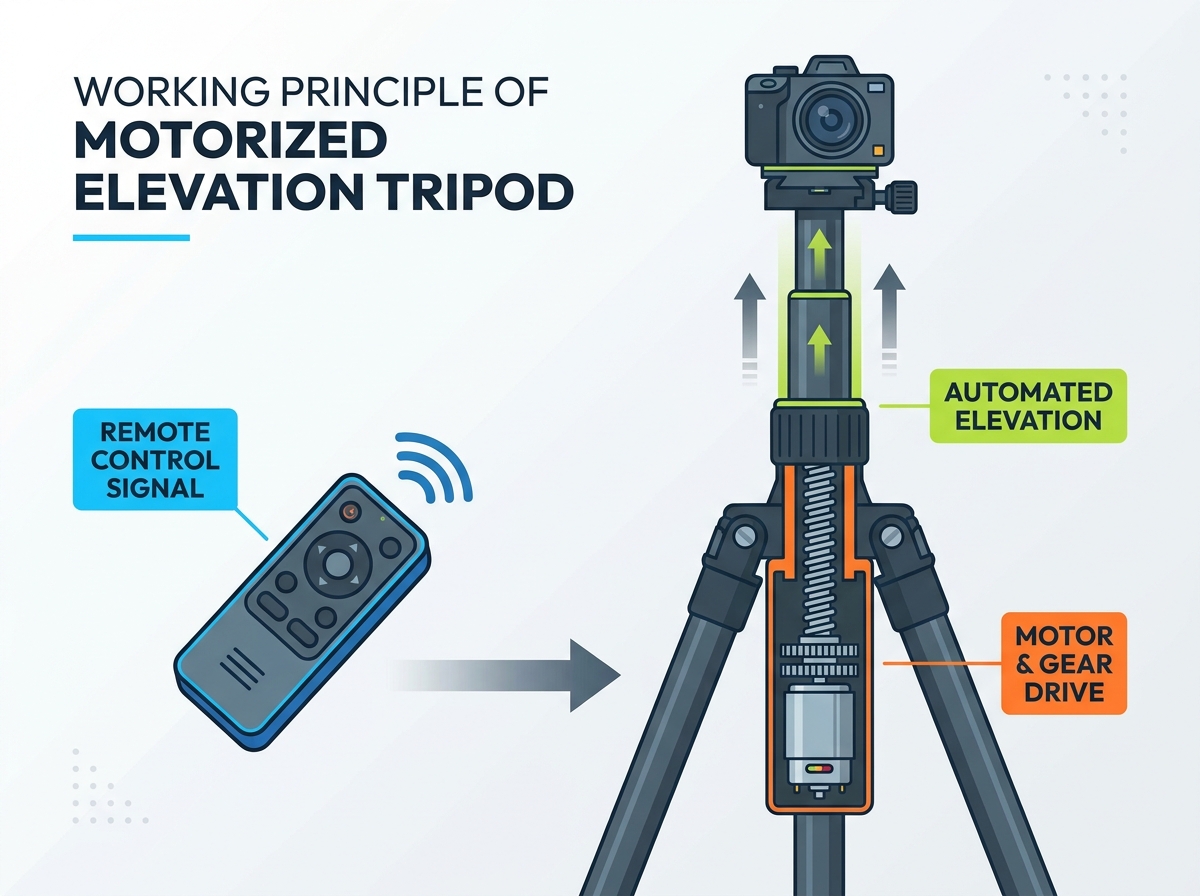
A motorized elevation tripod functions as a heavy-duty instrument stand equipped with an integrated electric motor and drive mechanism. Engineers designed these systems specifically to raise and lower a central column bearing heavy technical equipment without requiring physical exertion from the operator. You will typically see these deployed on large-scale construction sites, infrastructure inspection projects, and industrial metrology labs where precision is non-negotiable.
Standard friction-lock and manual rack-and-pinion crank tripods rely entirely on the operator's physical strength to elevate the payload. This manual approach introduces uneven lifting speeds, jerky movements, and the constant threat of the column slipping if the locking mechanism fails or is improperly engaged. Motorized variants shift this workload from physical operator force to controlled, battery-powered torque. The motor handles the heavy lifting, allowing the surveyor or technician to focus on instrument calibration and data collection rather than wrestling with a heavy mast.
An organization should consider adopting this technology when manual elevation causes measurable delays in scan registration. If your field crews struggle with repetitive lifting injuries after deploying a 20-pound scanner fifty times a day, the hardware upgrade makes immediate sense. Furthermore, operating in environments that require remote elevation adjustments—such as near hazardous materials or unstable edges—makes automated lifting a strict safety requirement rather than a luxury.
Feature | Manual Crank Tripod | Motorized Elevation Tripod |
|---|---|---|
Lifting Mechanism | Physical hand crank / rack-and-pinion | Electromechanical motor / worm-gear |
Payload Safety | Relies on friction locks and operator grip | Self-locking gears prevent back-drive |
Elevation Speed | Variable, depends on operator fatigue | Consistent, controlled millimeter adjustments |
Remote Operation | Impossible | Supported via Bluetooth, RF, or wired remote |
Weight | Lighter, highly portable | Heavier due to batteries and motors |
The core of the lifting capability relies on linear actuators, stepper motors, or brushless DC (BLDC) motors. These components generate the high-torque rotational force necessary to push heavy payloads vertically against gravity. BLDC motors are particularly common in high-end units because they offer excellent torque-to-weight ratios and do not suffer from brush wear over time.
The drive system utilizes a worm-gear configuration to translate the motor's rotational force into vertical column movement. This specific gear arrangement is intentional. Worm gears inherently prevent the central column from collapsing under heavy loads. Even during a complete power loss or battery failure, the gear teeth physically cannot be driven backward by the weight of the payload. This anti-back-drive characteristic acts as a permanent, fail-safe mechanical lock.
To protect the internal components, manufacturers integrate physical and optical limit switches inside the column housing. These switches detect when the mast reaches its maximum extension or full retraction. Once triggered, they instantly cut power to the motor. This prevents the system from over-extending, physically binding the gears, or burning out the motor by trying to push past its mechanical limits.
Mechanical play in gears, known as backlash, presents a massive engineering challenge for reality capture. If the central column wobbles even a fraction of a millimeter, the resulting point cloud data will suffer from severe registration errors. High-end motorized tripods mitigate backlash by using tightly machined gear tolerances and pre-loaded tensioning systems. This ensures the sensor payload remains perfectly stable and rigid once elevated to the target height.
Advanced systems integrate rotary encoders or linear glass scales to provide closed-loop feedback to the motor controller. The encoder constantly reads the physical position of the mast and feeds that data back to the control board. This allows the drive system to know the exact height of the sensor payload at all times, enabling operators to return the scanner to precise, repeatable elevations across multiple days of surveying.
Field operations demand robust and reliable power solutions. You will find several common power configurations depending on the manufacturer and intended use case:
Onboard lithium-ion (Li-ion) battery packs integrated directly into the tripod chassis.
Lithium iron phosphate (LiFePO4) batteries, which offer superior thermal stability and longer cycle life.
External 12V/24V DC power supplies connected via heavy-duty weatherproof cables.
Hot-swappable dual-battery configurations that allow continuous operation without powering down the system.
Battery chemistry heavily dictates cold-weather performance. At sub-zero temperatures, standard Li-ion cells experience significant voltage drop and capacity loss. Surveyors working in winter conditions must account for this by keeping spare batteries in warm vehicle cabs or utilizing specialized low-temperature battery housings.
Control methods vary widely. Basic models use wired hand controllers or integrated buttons on the column itself. More advanced units feature wireless Bluetooth or RF remotes, allowing the operator to step away from the tripod during elevation. Some systems even offer software-based API/SDK integration, enabling external data collectors or tablet software to send direct elevation commands to the tripod.
The central motorized column must interact flawlessly with the tripod legs to maintain structural rigidity. Heavy-duty struts, dual-leg bracing, and aggressive spiked feet anchor the system to the ground. The wider the leg spread, the lower the center of gravity, which is critical when a heavy scanner is elevated three meters in the air.
Motors inherently generate vibration. To prevent these harmonics from ruining sensitive data capture, engineers utilize specific dampening materials. Carbon fiber weaves in the leg tubes and specialized elastomeric couplers between the motor mount and the payload plate absorb high-frequency vibrations. The system is designed to settle completely within seconds after the motor stops moving, ensuring a perfectly static platform before the laser scanner begins its rotation.
Scanning complex infrastructure like bridges, tunnels, and multi-story atriums requires high-angle perspectives. If you set up a scanner at standard eye level, structural beams and floor grating will create massive scan shadows, blocking the laser from capturing the geometry behind them. Elevating the scanner resolves this. Motorized tripods allow field crews to achieve these high vantage points rapidly, resulting in faster setup times per scan station and significantly safer handling of heavy terrestrial laser scanners (TLS).
Deploying scanners upside down into utility vaults, storage silos, or mining shafts is a highly specialized but critical use case. Operators cannot safely stand inside these confined spaces. By utilizing a motorized tripod configured for inverted operation, crews can safely lower expensive sensors into the void. This motorized descent and ascent completely removes the need to expose personnel to hazardous atmospheres or unstable ground conditions.
Aerospace and automotive manufacturing environments demand extreme precision. Aligning laser trackers, industrial arms, and optical comparators requires exact line-of-sight to the tooling jigs. Manual elevation often causes jarring or bumping that disrupts factory calibration. Motorized elevation achieves the exact required height smoothly, preventing spatial coordinates from drifting and ensuring the metrology equipment remains perfectly leveled during the adjustment.
Temporary field deployments for security operations often involve heavy PTZ (Pan-Tilt-Zoom) camera arrays, microwave antennas, or acoustic sensors. These devices need to clear local obstacles to establish a clean line of sight or communication link. Motorized tripods enable rapid deployment and remote height adjustment. Operators can raise the mast from behind cover, avoiding exposure to hazardous sightlines while establishing the surveillance grid.
Law enforcement and forensic engineers must rapidly document crash sites, crime scenes, or structural failures. Capturing the entire site geometry from elevated viewpoints ensures no evidence is hidden behind vehicles or debris. Unobstructed high-angle scans completed quickly reduce road closure times and minimize scene contamination. The motorized tripod allows the investigator to elevate the scanner, capture the data, lower it, and move to the next station in a fraction of the time required by manual masts.
Understanding payload ratings is the most critical step in evaluating a system. Static load refers to the maximum weight the tripod can securely hold while stationary and locked in place. Dynamic load dictates the actual weight the motor and gear assembly can actively lift and lower without stalling the motor or stripping the gear teeth.
Always spec a tripod based on its dynamic load rating. You must calculate the total weight of your heaviest equipment configuration. This includes the scanner itself, onboard batteries, quick-release adapters, leveling bases, and tribrachs. Your chosen tripod should have a dynamic load rating at least 20-30% higher than this total weight to ensure the motor does not struggle during operation.
The physical dimensions of the tripod dictate its logistical feasibility. You must analyze the ratio between the collapsed transport length and the maximum operational height. A tripod that reaches four meters is useless if it cannot fit inside your survey truck.
Consider how the equipment will travel. Does the tripod fit into standard utility vehicles? Can it be packed into protective transit cases for air travel? You need a system that collapses down to a manageable size while still providing the necessary stroke length to clear obstacles in the field.
The materials used in the tripod's construction directly impact its weight, durability, and thermal stability. You must match the material to your specific field environment.
Material | Primary Advantage | Best Use Case |
|---|---|---|
Aluminum | Rugged, cost-effective, highly durable against impacts | Heavy civil construction, daily outdoor surveying |
Carbon Fiber | Excellent strength-to-weight ratio, high vibration dampening | Backcountry surveying, high-precision metrology |
Steel | Massive load capacity, extreme rigidity | Permanent indoor setups, industrial monitoring |
Thermal expansion coefficients also matter. Metal expands and contracts with temperature fluctuations. If you are conducting a long-duration scan in direct sunlight, an aluminum mast may expand slightly, causing spatial data drift. Carbon fiber exhibits minimal thermal expansion, making it superior for high-accuracy, long-duration setups.
Field equipment gets wet, dirty, and abused. Assess the importance of sealed motors, protected gearboxes, and weather-resistant electrical connections. You must look for specific Ingress Protection (IP) ratings based on your working conditions.
An IP54 rating provides basic dust and splash protection, suitable for general outdoor use. If you operate in dusty construction sites, damp underground mines, or wet environments, you need an IP65 rating or higher. This ensures the internal gears and motor windings are protected against water jets and fine particulate ingress that would otherwise destroy the drive mechanism.
Your expensive scanner must attach securely to the tripod mast. Verify that the tripod utilizes standard thread sizes, such as the industry-standard 5/8" x 11 thread. Check the availability of quick-release adapter plates or specialized mounting hardware designed for your specific instrumentation.
A secure, slip-free coupling is mandatory. If the connection between the scanner and the mast has any play, the rotational force of the scanner will cause it to wobble, ruining the data. Ensure the tripod head is compatible with standard surveying tribrachs for precise leveling before elevation.
Motorized tripods are inherently heavier than their manual counterparts. The addition of copper motor windings, steel gearboxes, and dense lithium battery packs adds significant mass. This reduces portability for single-operator backpacking scenarios. However, this added weight significantly increases wind resistance and base stability in high-draft areas, anchoring the system more firmly to the ground.
The initial capital expenditure of a motorized system is undeniably high. Buyers must calculate their return on investment logically. Factor in the reduction of time spent leveling and elevating at each scan station. Multiply those saved minutes by the number of stations per day, and then by the number of working days in a year. Add the financial mitigation of avoiding workplace injury claims related to heavy lifting. The long-term efficiency often outweighs the upfront cost for high-volume scanning teams.
Maintenance complexity also increases. Manual tripods require basic dry-lubrication on the rack and occasional lock tightening. Motorized tripods introduce battery degradation, electrical contact cleaning, weather-sealing wear, and eventual motor servicing into your equipment maintenance schedule. You must be prepared to manage these electrical components to keep the system operational.
Field power failure remains the most common operational risk. If the battery dies while the mast is fully extended, you cannot pack up your gear. To mitigate this, ensure the selected model features a mechanical manual override. This usually takes the form of a backup hand crank or a hex-drive port that accepts a standard cordless drill. Always invest in redundant, hot-swappable batteries and keep them charged in the truck.
Wind-induced vibration and mast drift at maximum extension can severely compromise point cloud data. A three-meter mast acts as a lever arm in high winds. Implement strict standard operating procedures for your field crews, mandating a 10-to-15-second settling time after any elevation adjustment before starting the scan. Utilize specialized guy-wire kits, heavy outriggers, or sandbag weights on the tripod base to anchor the system in high-wind environments.
Operator error, pinch points, and tip-overs present physical hazards. Ensure the device features automatic overcurrent and torque-limiting detection. This safety feature instantly stops the motor if an obstruction or pinch occurs, preventing injury or equipment damage. Train your teams on proper leg-spread ratios, outrigger leveling, and the mandatory use of bubble levels prior to engaging the motorized column to maintain the center of gravity.
Operating in hazardous environments like oil refineries, chemical plants, or underground coal mines introduces explosion risks. Standard electric motors can generate microscopic sparks. Verify if the motorized tripod possesses ATEX, IECEx, or Class I, Div 1/2 intrinsic safety certifications. These certifications guarantee the electrical components are sealed and will not ignite combustible dust or gas in the atmosphere.
A motorized elevation tripod serves as a critical infrastructure upgrade for teams managing heavy reality capture payloads, executing high daily scan volumes, or conducting operations that require elevated lines of sight. While not necessary for basic, lightweight surveying tasks, the safety and efficiency gains for heavy 3D laser scanning are undeniable.
Audit the exact dynamic weight of your current scanner, batteries, and tribrach configurations to establish your baseline load requirement.
Review the IP ratings of your shortlisted tripods against the harshest environments your field crews operate in.
Disqualify any motorized model that lacks a mechanical manual override for emergency retraction.
Reach out to your equipment dealer to contact us and request a physical field demonstration to test motor smoothness and safety stops under real-world conditions.
A: Yes, most professional-grade models include a mechanical manual override. This typically involves a backup hand crank or a specific port designed for a hex key or cordless drill. This fail-safe allows field crews to safely lower or raise the equipment and pack up the site even during a complete electrical power failure.
A: Static load capacity refers to the maximum weight the tripod can securely hold once the mast is locked in place and stationary. Dynamic load capacity is the maximum weight the internal motor and gear assembly can safely lift and lower while in active motion without stalling or causing mechanical damage.
A: Only specialized models designed specifically for inverted operation should be used upside down. These units feature structural lockouts, inverted gear configurations, and dedicated safety retention systems to prevent the payload from detaching. Always verify manufacturer specifications for inverted approval before deploying equipment into a shaft.
A: The motor does create high-frequency vibration during the actual movement of the mast. However, the tripod is engineered to be completely static during the scan itself. High-quality models utilize vibration-dampening materials and rigid mechanical locks to ensure absolute stability and zero harmonic resonance once the target height is reached.
A: Cold temperatures significantly reduce lithium battery capacity and can thicken internal gear grease, causing higher mechanical resistance for the motor. High-end models mitigate this by utilizing low-temperature synthetic lubricants and specialized battery chemistries designed to maintain voltage and performance in freezing field conditions.